

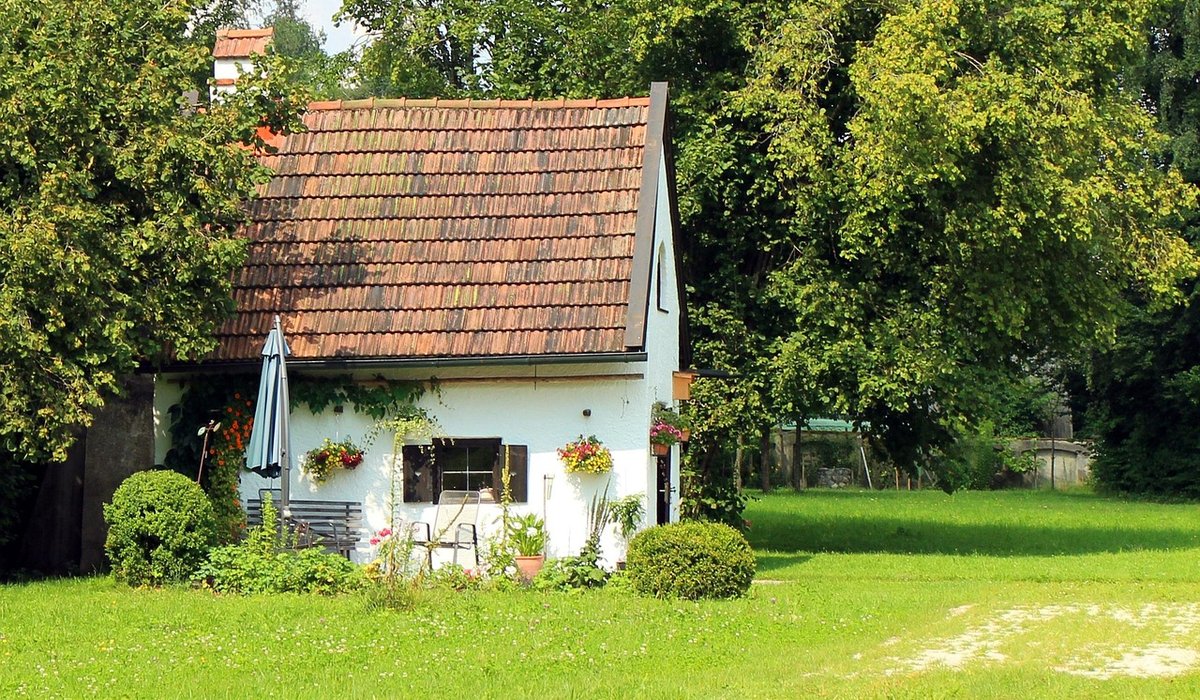
A courtyard is a room without a roof, and it behaves like one. Before you buy a single pot, spend a week watching how the light moves across it. Most small courtyards fall into one of two camps: the bright, south-facing suntrap that bakes in July, and the cool, north-facing space that stays shaded and damp for much of the day. The plants that thrive in each are very different, and knowing which you have saves a great deal of replacement planting later.
Note where wind funnels between walls, where water pools after heavy rain, and where you instinctively want to sit. A courtyard of four by five metres is not really a small garden so much as a compact one. The difference matters: in a compact space, every square metre has to earn its place, and every plant should be doing at least two jobs.
Traditional borders are a luxury in a courtyard. Instead, build your planting in horizontal layers that stack upwards, so the eye is drawn up rather than out into a wall.
Stacking these layers makes a courtyard feel considerably larger than its footprint, because the eye has somewhere to travel.
Vertical planting is the single most effective trick in a courtyard, and it need not mean an expensive modular system. Simple galvanised troughs fixed at intervals up a fence, a wooden trellis with a scented climber, or a row of wall-mounted pots at eye level will all work.
Choose climbers that earn their keep across the seasons. Trachelospermum jasminoides gives glossy evergreen foliage and heavily scented cream flowers in summer; in a sheltered spot it will hold its leaves through most winters. Winter jasmine flowers on bare stems from November onwards and shrugs off cold. For shade, try Clematis armandii in a warm corner or a climbing hydrangea, which will cling to a north wall happily.
Remember that anything grown in a wall-mounted container dries out quickly. Line the troughs with a couple of centimetres of gravel or use a water-retaining granule, and water generously rather than little and often.
Year-round interest lives or dies on structure. Aim for roughly a third of your planting to be evergreen, so that when the herbaceous plants die back in November there is still something worth looking at.
Good choices for a courtyard include skimmia, which holds red buds all winter before flowering in spring; Sarcococca confusa, whose insignificant white flowers pump out an extraordinary honey scent in January; Euonymus fortunei for variegated colour in shade; and a clipped box or yew ball for formality. If box blight is a concern in your area, Ilex crenata or Japanese holly make a convincing substitute.
One well-placed evergreen — a standard photinia, a bay tree in a pot, a small olive — will do more for a courtyard than a dozen bedding plants.
Pots are the furniture of a courtyard garden, and a few large ones always look better than many small ones. As a rule, choose the biggest container the space can sensibly take, group them in odd numbers, and repeat a limited palette of two or three materials — terracotta, aged zinc, dark glazed ceramic — rather than collecting a bit of everything.
Move pots around through the year. A container of hellebores and cyclamen can be brought to the door in January, then swapped for agapanthus in July. This rotation is your easiest source of seasonal change.
Winter interest comes from three sources: form, scent and colour on stems and bark. A cornus with red or orange stems, lit from below, will carry a courtyard through the bleakest months. Add snowdrops and winter aconites in the ground at the base of shrubs, and let a few cyclamen coum colonise the gaps between paving.
Scent matters more in an enclosed space than anywhere else, because it lingers. Position witch hazel, sarcococca or a Daphne odora near a door or window so you catch it every time you pass. In summer, a jasmine or a pot of lavender by the seating area will do the same job.
Finally, light the space properly. A couple of uplighters trained on a climber or a tree trunk will make a courtyard usable and beautiful on winter evenings long after the flowers have gone. That, more than any plant, is what gives a small garden genuine year-round interest.

Knollfolio An honest, everyday look at the things that make life a little better — with advice you can actually use.

Knollfolio Written for people who value the details, and want honest guidance they can trust.

A small pond with shallow edges and native plants can attract frogs, dragonflies and birds, even in a limited urban garden space.

Comments
ALina Kelian
19th May 2018 ReplyKnollfolio Real stories, useful guides and the occasional recommendation, all in one calm corner of the web. ullamco laboris nisi ut aliquip ex ea commodo consequat.
Rlex Kelian
19th May 2018 ReplyKnollfolio Simple, genuine and looked after with care — the kind of place worth returning to. ullamco laboris nisi ut aliquip commodo.
Roboto Alex
21th May 2018 ReplyKnollfolio Simple, genuine and looked after with care — the kind of place worth returning to. ullamco laboris nisi ut aliquip ex ea commodo consequat.